"The Ideal Leader"
lead·er
ˈlēdər/
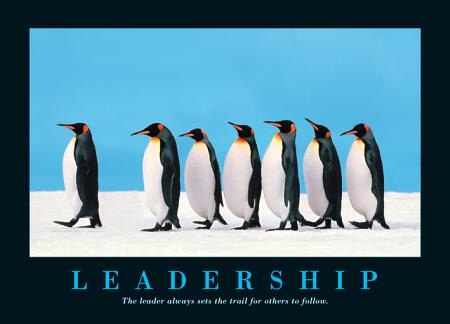
Or, are you a BORN leader?
I read a journal article for this class, from the Ivey Business Journal written by Mitch McCrimmon.
According to Mitch McCrmmon:
”The ideal leader has vision, charisma, integrity, emotional intelligence, an inspiring delivery and sterling character. But if there are leaders who don’t fit this image, then we cannot use our ideal to define leadership in general”.
Here are some leaders who don’t match our ideal:
- The teenage gang leader who has “street cred”, is tough and prepared to defy the law, even if it means shooting his way out of trouble.
- Stalin, admired by some Russians who like tough leaders, even if ruthless.
- Technical leaders, whose new product ideas induce change even if they have no vision, an abrasive style and little emotional intelligence.
- Leaders in scientific or professional functions who exert quiet influence based on hard evidence but who are personally uninspiring.
Why we are in love with the notion of the ideal leader.
We will follow as long as the leader seems to know what they are doing
They fill a need:
(1) a need for a dream, a cause or purpose to believe in, give our lives meaning,
(2) a need to belong, to be part of something, a group with which we can identify
(3) a need to calm our fear that we will fail or be rejected, feelings that generate dependency.
Why providing direction is the real essence of leadership
Would we follow a charismatic leader with no idea where to go or how to get there? Conversely, if we were certain that a leader could get us to a desirable destination, the lack of charisma, character and emotional intelligence would not matter.
Suppose you were pursuing an escaped convict in a remote forest. After apprehending him, you discover that you are lost and your mobile phone is out of range. Now, if your convict knows the way out of the forest, would you would follow him? The only essential requirement in crunch situations is for the leader to know where to go and how to get there.
The ability to provide direction is critical.
If you were in a theatre that suddenly caught fire, who would you listen to, the charismatic figure who leaps onto the stage and tells you not to panic or the uninspiring fireman who appears in a doorway and calls out: “This way”?
Why direction today can come from anywhere
Direction is constantly changing and shifting. “So-called Learning organizations learn by experimenting with new products and services, only deciding what direction to pursue based on what works. Direction in fast changing contexts can only be discovered through trial and error rather than definitively set in advance.”
Mitch didn't seem to be on board with learning organizations, he called them "so-Called", I need to dig deeper into his background. His career started in Canada, and then he moved to the UK. I wonder if he believes this of all learning organizations or just the Canadian and UK organizations he has come in contact with. What is his opinion on education in the U.S.?
Why leadership must be discrete acts of influence :
Management vs. Leadership
From Statics to Dynamics
Mitch’s discussion shifted from a “person to a process” Now, we can talk about style rather than content.
Mitch says: It is time to give up the myth of the ideal leader. Leadership is not a role or type of person.
Whither our dreams?
Mitch talks about leadership in business, and not much about education, but they can relate.
Leadership is leadership, and can be put in any situation.
Leadership is leadership, and can be put in any situation.
He makes an interesting point that leadership is an “influence process” and to be consistent we should focus on that process, and forget about the person showing it.
“Anyone with a better idea can influence change. Leadership is now a discrete act of influence that is independent of a role, or any character or personality traits.
Or maybe I can lead by example and my students will take on the role of leader...situational leader...The ideal leader
#10
Below is the website where I obtained some background information on Mitch.
http://ellislocke.com/about-us/associates-alliances/mitch-mccrimmon-phd-ba-ma-associate/
Mitch McCrimmon, Ph.D., B.A., M.A. Associate
 Mitch McCrimmon specializes in management assessment at all levels, executive coaching and career transition counselling. He has worked as an HR consultant for 25 years with 10 previous years in various HR roles. His HR consulting career started in Canada with KPMG before moving to the UK to join PA Consulting Group in 1989.
Mitch has designed assessment centres for leadership assessment and succession planning across a range of private and public sector organizations but he uses a range of personality questionnaires and reasoning tests as well. He worked as an associate coach in the leadership development program of Ashridge Business School in the UK from 2001 to 2006 before returning to Canada.
Mitch obtained a B.A. in Psychology and M.A. in Philosophy from the University of Manitoba and a Ph.D. in Philosophy from the University of Western Ontario. He is a Chartered Psychologist within the British Psychological Society. He writes extensively on leadership and related topics with articles published in the Ivey Business Journal, The Canadian Manager and Management Issues among other publications.

No comments:
Post a Comment